Why a Statement Tennis Necklace Is a Strong Starting Point for Your Look
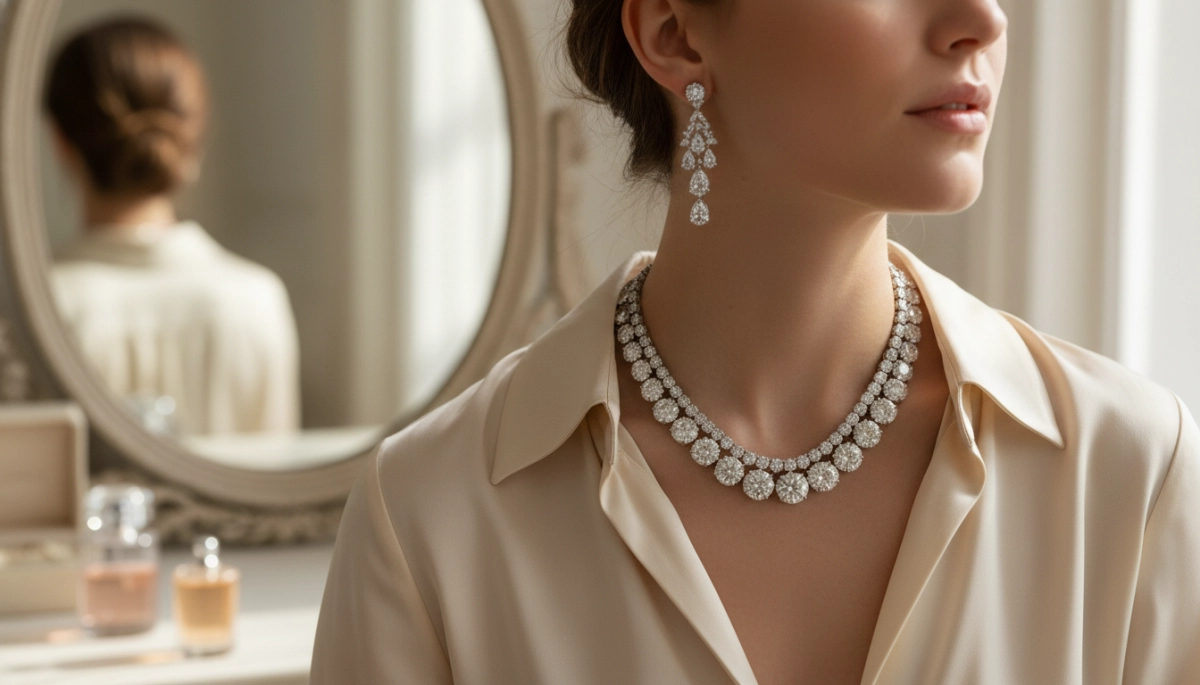
You already know the classic tennis necklace: a continuous row of closely set stones that follows the curve of your collar. When the piece is scaled up into a statement tennis necklace — larger stones, denser sparkle, sometimes a wider band — it becomes the focal point of your jewelry narrative. Styling earrings with this kind of necklace requires intention: you want harmony rather than visual competition.
Begin by assessing the specific attributes of your necklace. Ask yourself: How wide is the band? How large are the stones? Is the setting yellow gold, white gold, or platinum? Does the necklace sit high like a choker, mid-collar, or lower on the chest? These details determine the visual weight and the negative space around your face, which in turn guide your earring choices.
Key necklace traits that affect earring selection
- Scale: Larger stones read bolder. If your necklace is chunky, choose earrings that balance rather than match the scale exactly.
- Sitting height: A choker-style tennis necklace leaves little neck space and pairs well with smaller or mid-length earrings; a lower necklace can handle longer drops.
- Metal and color: Matching metal tones creates cohesion; contrasting metals can work if repeated elsewhere in your outfit (belt, bag hardware).
- Stone color and cut: Clear, colorless stones are versatile; colored gems call for restraint in complementary accessories.
Practical Rules for Pairing Earrings with a Statement Tennis Necklace
Think of the necklace as the lead instrument and your earrings as the harmony. Your goal is to create a pleasing composition by considering proportion, rhythm, and focal points. Use these straightforward rules when you plan your jewelry pairings.
Simple guidelines to follow
- Keep one focal point: If the necklace is dramatically oversized, make the earrings subtle — studs, small hoops, or delicate huggies.
- Mirror shapes sparingly: Echoing a facet or shape from the necklace in your earring design (e.g., round stones with round studs) ties the look together without overpowering it.
- Consider face frame: Long earrings elongate the neck and work well with V-necks and low collars; short earrings keep attention on the necklace and suit higher necklines.
- Layered metals and textures: If you mix metals, use one of them in small doses on your earrings so the ensemble still reads intentional.
Below, you’ll find specific earring styles and the outfits they best complement — from minimal studs for formal events to bold drops for evening wear — along with tips on balancing proportion and color.
Earring Styles That Play Nice with a Statement Tennis Necklace
When the necklace is the superstar, think of your earrings as the supporting cast that helps the scene without stealing it. Here are go-to styles and when each works best:
– Studs: The safest, most versatile option. Large solitaires or classic round brilliant studs read elegant against an oversized tennis necklace without competing. Opt for proportion — a stud the diameter of a pencil eraser or slightly larger complements most statement pieces. Pearl studs lend a softer contrast to lots of sparkle; colored gemstone studs can echo a single stone tone from the necklace.
– Huggies and small hoops: These hug the earlobe and create a modern, unobtrusive frame. They’re ideal with choker-height tennis necklaces or very wide bands because they keep vertical visual clutter low. Choose plain metal for a streamlined look or pavé-set huggies if you want a whisper of extra sparkle.
– Mid-length drops and tapered hoops: If your necklace sits lower on the collarbone and the stones are medium-sized, a mid-length drop (think 1–2 inches) or a slender tapered hoop can balance length without competing. Keep the drop silhouette narrow and avoid dense, voluminous chandeliers unless the necklace is relatively restrained.
– Statement drops and chandeliers: Reserve these for when the necklace is either more delicate than it looks at first glance or when you’re intentionally doubling down for an evening look. If you pair two statement elements, make one element linear and the other compact (for example, a wide tennis necklace with long, slim drops) so the eye has a pathway to follow instead of two equal focal points.
– Ear cuffs, climbers, and single-ear accents: These urban touches work beautifully with bold necklaces when you want edge without scale competition. Use them on their own or layered with tiny studs; because they occupy a vertical, architectural space on the ear, keep them in the same metal family as the necklace to read coherent.
Multiple Piercings, Asymmetry, and the Art of Layered Ear Styling
If you have more than one piercing, you have a powerful tool to balance visual weight while staying true to the necklace’s dominance.
– Scale progression: Arrange earrings from smallest at the top to largest at the lobe. Start with micro-studs or small huggies in upper holes, graduating to a single larger stud or a slim drop in the main lobe. This creates rhythm that complements a continuous necklace line.
– Anchor and echo: Choose one anchor earring — usually at the primary lobe — that echoes a detail from the necklace (stone shape, metal tone). Use smaller, simpler pieces in the additional piercings to echo the anchor subtly. For example, a princess-cut-stone lobe stud can be accompanied by tiny round pavé studs above it.
– Intentional asymmetry: A well-executed mismatch can look chic. Try a single statement drop in one ear and a trio of coordinating huggies or studs in the other. The key is repetition: repeat at least one material, shape, or color between both sides so the look reads purposeful rather than accidental.
– Comfort and balance: Heavy layered earrings can tug the earlobe and change how the necklace sits. Alternate heavier pieces with lighter ones and distribute weight symmetrically when possible to avoid pulling the focal point down on one side.
These approaches let you personalize the ensemble while ensuring the statement tennis necklace remains the guiding note of your jewelry composition.
Putting the Look Into Practice
Now it’s time to take what you’ve learned and make it your own. Start with one rule—necklace as the primary focus—and experiment within that framework: try a pared-back stud with a wide, choker-style tennis necklace one day, then test a slim drop with a lower-sitting piece another. Pay attention to comfort, proportion, and how the ensemble reads from a distance as well as up close. Confidence is the final accessory; when you feel balanced, the styling will read polished.
Care and fit matter as much as design. Check clasps and earring backs before you leave the house, distribute weight across multiple piercings if needed, and store pieces flat to avoid kinks in a wider band. For guidance on gemstone care and safe wear, see GIA’s jewelry resources.
Key Takeaways
- Make the tennis necklace the focal point: choose earrings that balance scale and silhouette rather than compete with it.
- Match metal tones or repeat a single shape or stone to create cohesion; use graduated or minimalist pieces with multi-pierced ears.
- Prioritize comfort and secure fittings—test combinations in natural light and adjust weight distribution to keep the look polished all day or night.