Nadal’s transformation from a clay prodigy to an enduring champion is defined by unrivaled topspin and tactical ferocity, a relentless physicality that produced a record 14 Roland Garros titles, and strategic adaptations to emerging rivals. This guide traces his technical refinements, mental resilience amid season-threatening injuries, and how his clay-court innovations reshaped modern play, offering lessons on training, matchcraft, and longevity at the sport’s most demanding major.
Types of Dominance
Nadal’s grip on Roland Garros splits into physical, tactical, surface mastery, psychological and statistical dominance: relentless topspin and footwork, superior point construction, unrivalled clay timing, intimidation in key moments, and a record unmatched by peers. Knowing how these layers interact explains why he converted sporadic advantages into sustained supremacy.
| Physical | Explosive movement, heavy topspin forehand that skids opponents off position. |
| Tactical | Point construction that targets backhand patterns and uses angles to open court. |
| Surface Mastery | Adaptation to clay pace, superior slide technique and grip on high-bouncing balls. |
| Psychological | Match-by-match intensity, often rising in semifinals/finals to impose pressure. |
| Statistical | Accumulation of Roland Garros records, including a haul of 14 titles that forces opponents into defensive tactics. |
- Physical
- Tactical
- Surface Mastery
- Psychological
- Statistical
Early Career Success
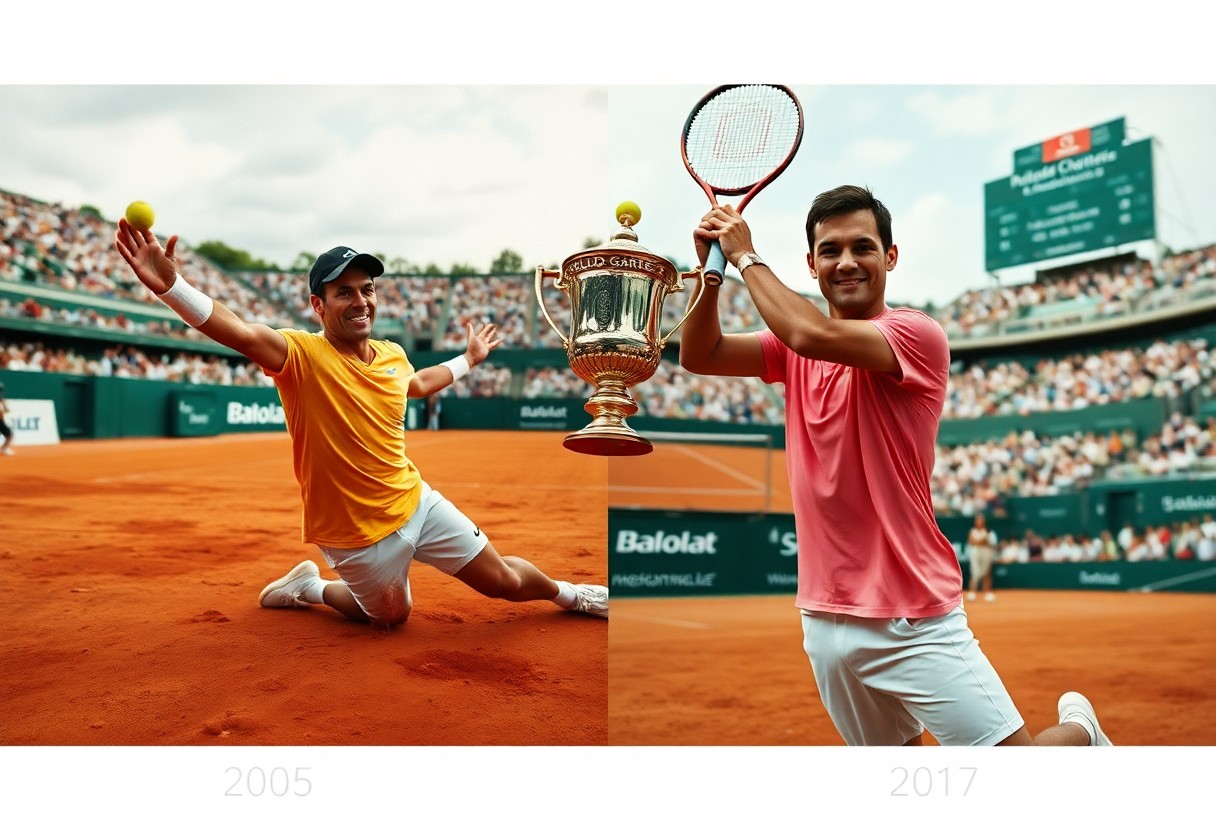
At 19 Nadal won his first Roland Garros title in 2005, beginning a run of dominance highlighted by four consecutive finals wins from 2005-2008; his 2005-2008 stretch established topspin, relentless defense and sustained pressure as hallmarks that overwhelmed opponents used to faster courts.
Recent Performance Trends
His 2022 victory over Casper Ruud for a record 14th title demonstrated refined courtcraft at age 36, with selective scheduling and emphasis on recovery allowing peak performance at Roland Garros despite a lighter calendar and recurring physical setbacks.
More granularly, recent seasons show deliberate tactical shifts: shorter point construction when possible, increased use of the backhand slice to change rhythm, and serving patterns aimed at reducing extended rallies. Match selection has tilted toward clay lead-ups that preserve energy, and when rallies extend beyond 20 strokes his historical edge narrows-making endurance management and strategic point-closing (aggressive forehand, targeted serve placement) decisive factors in late-round outcomes.
Factors Contributing to Nadal’s Success
- Heavy topspin that forces opponents back and exploits clay’s high bounce
- Left-handed angle creating tactical forehand openings and targeting opponents’ backhands
- Exceptional footwork and sliding technique for quick recovery and control
- Physical endurance enabling dominance in long, grueling best-of-five matches
- Mental resilience to raise intensity in decisive sets and pressure points
The synthesis of these elements, combined with tactical evolution and season planning, explains the sustained Roland Garros dominance.
Playing Style Adaptation
He progressively varied tactics – adding serve placement, occasional slice backhands and more frequent net forays – to shorten points and offset wear; his signature heavy topspin forehand and exaggerated inside-out angles remained primary weapons, while disciplined point construction and a higher first-serve percentage on clay reduced break vulnerability against specialists.
Physical and Mental Resilience
Sustained investment in recovery, targeted conditioning and match pacing let him manage chronic issues and still outlast rivals; emphasis on pre-tournament load management and on-court energy conservation underpins his ability to elevate intensity in fifth sets and long rallies, showcasing endurance and disciplined injury management.
Across a 17-year span (first title in 2005, last in 2022) he captured 14 French Open titles, evidencing how strategic rest, surgical/medical interventions when necessary and adaptive training deliver results; for example, after a limited 2016 season he retooled preparation and reclaimed the crown in 2017, and later adjusted tournament selection to peak at Roland Garros, turning recovery protocols and mental routines into measurable advantages in multi-hour matches.
Tips for Aspiring Players
Adopt Nadal-style emphasis on clay-specific skills: heavy, high-bouncing topspin, aggressive sliding, and relentless point construction; practice long-rally tolerance with 20-30 minute continuous-rally drills and include 3 weekly interval endurance runs of 30 minutes to mimic match intensity. Also include technical sessions focused on kick-serve and drop-shot defense. The priority is match-ready movement, spin, and tactical patience that produced 14 Roland Garros titles.
- Topspin
- Sliding footwork
- Endurance
- Tactical point construction
- Mental routines
Training Regimens
Combine on-court repetition with gym work: aim for 5-6 practice days featuring 90-120 minute on-court sessions, 2 strength sessions per week (emphasizing eccentric leg strength and rotational core), and plyometrics twice weekly to support explosive sliding. Drill specifics: 500-ball topspin forehand sets, 15-minute serve-and-return pressure blocks, and situational sets starting from 0-30 and 30-30 to build tactical conditioning. Emphasize intensity and measured recovery.
Mental Preparation Strategies
Use daily mental routines: 10-minute visualization before practice, breathing drills to lower heart rate by 10-15% during changeovers, and scripted cues for reset after errors. Replicate pressure with 20 weekly simulated break-point scenarios and match-deciding point drills to build composure. Study opponent patterns between sets and keep a short tactical checklist. Highlight pre-serve routine and process-focused goals.
Work with a sports psychologist to quantify progress via metrics: track unforced-error rates under simulated pressure, log confidence scores after each session, and set incremental targets like reducing double faults by 30% across six weeks. Implement journaling to externalize thoughts and rehearse coping scripts for momentum swings; practice crowd-noise simulations and fatigue scenarios to ensure match-ready resilience.
Step-by-Step Breakdown of Nadal’s Key Matches
2005 (Puerta), 2008 (Federer), 2009 (Söderling upset), 2010 (Söderling redemption), 2012 (Djokovic), and 2022 (Ruud for his 14th Roland Garros) map the arc of tactical evolution: from relentless topspin and court coverage to selective aggression and serve variation, with each match revealing specific adjustments that extended his clay supremacy.
| Key Matches Breakdown | |
|---|---|
| 2005 – Final vs Mariano Puerta | First major title: established the signature heavy topspin forehand and unmatched court coverage that forced opponents into errors and long rallies. |
| 2008 – Final vs Roger Federer | Peak dominance: exploited Federer’s one-handed backhand with high-bouncing forehands and relentless depth, turning short windows into decisive breaks. |
| 2009 – Fourth Round vs Robin Söderling | Upset loss that exposed vulnerability to flat, aggressive hitting, prompting tactical refinements in pace and serve placement for later campaigns. |
| 2010 – Final vs Robin Söderling | Redemption match: increased first-serve percentage and stepped into shorter balls, mixing defense with timely offense to close out the title. |
| 2012 – Final vs Novak Djokovic | Displayed endurance and mental resilience in momentum swings, using depth and angles to disrupt Djokovic’s rhythm across pivotal games. |
| 2022 – Final vs Casper Ruud | Strategic maturity: combined measured aggression with patience, converting key break points to secure his 14th title. |
Notable Finals
Across his finals, the pattern is clear: repeated trophies against top rivals (multiple finals vs Federer, later decisive wins over Söderling and Djokovic) show tactical layering-higher first-serve rates, more angled forehands, and situational shortening of rallies-culminating in the composure that produced his 14 Roland Garros titles.
Turning Points in His Matches
Turning points often came when Nadal shifted from baseline attrition to targeted aggression: stepping inside the court for an inside-out forehand, varying serve direction, or raising the first-serve percentage to seize a late break-small adjustments that flipped momentum in tight sets.
Technically, those shifts included deliberately higher, heavier forehand trajectories to exploit opponents’ backhands, tighter serve placement to earn free points, and selective volleying to finish points sooner. For example, after the 2009 setback he emphasized serve variation and shorter point construction; in later battles with Djokovic he mixed depth with occasional unpredictability, and in the 2022 final he used patience plus opportunistic aggression to convert crucial breaks.
Pros and Cons of Nadal’s Playing Style
Pros vs Cons
| Pros | Cons |
|---|---|
| Heavy topspin forehand that generates high-bouncing, defensive-to-offensive transitions. | Vulnerable to flat hitters; example: his 2009 Roland Garros upset by Robin Soderling. |
| Extraordinary court coverage and sliding technique that extends rallies in his favor. | Injury interruptions (heel/knee issues) reduce mobility and effectiveness. |
| Physical endurance and stamina enabling repeated five-set comebacks at Roland Garros (14 titles). | Less effective on very fast surfaces where low, flat shots negate topspin. |
| Left-handed spin advantage that opens the court and exploits opponents’ backhands. | Net play limitations – occasional discomfort finishing points at the net against aggressive volleyers. |
| Mental resilience and tactical adaptability across long matches. | High error count when forced to shorten points or when taking more risks to finish points. |
| Exceptional return and break-point conversion on clay due to depth and spin. | Predictable patterns can be exploited by players who take the ball early and flatten rallies. |
Strengths on Clay
His combination of 14 Roland Garros titles, relentless footwork and a forehand that generates exceptional topspin creates a unique clay profile; opponents repeatedly struggle with his ability to turn defense into offense, his kick serve opens the court, and his slide mechanics allow him to retrieve low-driving winners-these traits produce a match-winning margin of error that few clay specialists can match.
Limitations Against Different Opponents
Against opponents who step inside the court and hit flat, early winners-like Robin Soderling in 2009-Nadal’s high-bounce game can be neutralized; additionally, tall big servers and players who shorten rallies on faster surfaces reduce the effectiveness of his topspin and court-covering advantage, while his performance noticeably dips when leg injuries hamper lateral speed.
More specifically, successful tactics versus Nadal often include taking the ball on the rise to rob him of time, targeting his backhand with flat drives, and mixing deep, low trajectories that prevent him from generating his usual looped forehand rhythm. On faster courts, a serve that consistently produces free points (using pace and placement rather than spin) forces him into fewer extended rallies, increasing his unforced errors. Coaches studying Nadal emphasize early aggression and depth management-forcing him to play on the back foot reduces his break-point conversion and exposes short bursts of tactical rigidity that elite returners can exploit.
The Future of Nadal’s Legacy at the French Open
Achievements and Records
Across a career that began with his 2005 breakthrough at age 19, Nadal has built an unparalleled Roland Garros résumé: 14 titles and dominance that redefined clay-court tennis. He assembled an early clay streak of 81 consecutive wins, set the record for most titles at a single Grand Slam, and produced landmark finals-2008, 2010-14, 2017-19, 2020, 2022-that underline a legacy of sustained excellence and match-winning adaptability on slow courts.
Predictions for Upcoming Tournaments
Given his history, Nadal remains a dangerous contender whenever fit, yet form will hinge on scheduling and recovery against top rivals like Novak Djokovic, Carlos Alcaraz, Jannik Sinner, and Casper Ruud. Expect strategic shifts: shorter points, increased slice and drop shots to protect physical limits, and selective entry into lead-up clay events. Tournament outcomes will likely depend more on match rhythm and medical management than raw clay pedigree alone.
Examining plausible draws, a quarterfinal clash with Djokovic or Alcaraz poses the toughest test-both combine baseline depth with court coverage that can exploit movement lapses. Coaches and analysts should monitor match minutes and warming patterns; injury history and age-related recovery will determine whether Nadal targets a title push or selective appearances focused on legacy milestones rather than full Grand Slam campaigns.
To wrap up
Drawing together Rafael Nadal’s evolution at the French Open reveals how relentless physical conditioning, strategic adaptation, and technical mastery of clay combined to produce unmatched success; his early ferocity, mid-career refinement of topspin and point construction, and later tactical intelligence and recovery routines extended his reign, reshaping clay-court standards and influencing generations of players.
FAQ
Q: How did Rafael Nadal develop the clay-court game that made him dominant at the French Open?
A: Nadal’s clay mastery grew from a combination of early specialization on Spanish clay, an unusually heavy left-handed topspin forehand that exaggerated ball bounce, and exceptional footwork and sliding technique. Intense repetition of high-bounce rallies in training built his ability to dictate points from the baseline, and a disciplined physical regimen gave him the stamina to outlast opponents in long matches. Coaching continuity, especially with his uncle Toni Nadal during his formative years, reinforced a relentless, point-by-point mentality that translated exceptionally well to Roland Garros.
Q: Which tactical and physical attributes made Nadal almost unbeatable on clay?
A: Tactically, Nadal constructs points to open angles and attack opponents’ weaker wings, often using heavy topspin to push opponents back and create short ball opportunities. He mixes deep, penetrating groundstrokes with expertly timed drop shots and angled winners to disrupt rhythm. Physically he combined elite endurance, explosive recovery between points, and a high pain threshold, allowing him to maintain intensity through extended five-set battles and wear down rivals across the fortnight.
Q: How has Nadal’s dominance at the French Open evolved through his career and what adaptations allowed him to keep winning as he aged?
A: Early in his career Nadal overwhelmed opponents with physicality and relentless defense, producing an unprecedented run of titles. After recurring injuries and advancing age, he adapted by shortening points where possible, improving serve variety and placement, and increasing net forays to finish points quicker. He also adopted smarter scheduling and recovery practices, leaned on match experience and tactical nuance to offset reduced mobility, and continued to win multiple Roland Garros titles-demonstrating an evolution from pure attritional dominance to a more strategic, efficiency-focused approach.