From grass-court origins to global stardom: how men’s tennis produced its legends
You may think of tennis legends as simply the players who won the most trophies, but the story is deeper: it’s about cultural impact, evolution of technique, and moments that changed how the game is played and watched. This section helps you place those great careers into context so you can appreciate why certain names transcend statistics and why their rivalries became chapters in sporting history.
As you read, consider three overlapping forces that shape legendary status: long-term excellence, signature moments that define eras, and the ability to adapt across surfaces and generations. Understanding these forces gives you a framework for evaluating champions from early pioneers on grass to modern power baseliners on hard courts.
How greatness is measured: records, style, and lasting influence
When you judge the greatest men in tennis history, look beyond simple tallies. Here are common measures that experts and fans use to compare careers:
- Grand Slam titles and era-adjusted achievements — The number of major wins remains a core metric, but you should also consider the competitiveness of those eras and differences in calendar structure.
- Surface versatility — Champions who mastered grass, clay, and hard courts demonstrated adaptability that often separates a great player from a true legend.
- Head-to-head rivalries — How a player performed against contemporaries in big matches often defines legacy more than dominant runs in weaker fields.
- Longevity and comeback ability — Sustained excellence over a decade or more, or dramatic returns from injury, add to a player’s mythos.
- Innovations in technique and tactics — Players who introduced new strokes, movement patterns, or strategic approaches influenced how future generations learned the game.
By applying these lenses, you won’t just memorize statistics — you’ll understand why certain matches or seasons are remembered for decades. This perspective makes it easier for you to see how a single moment, like a match point under pressure, can elevate a champion into legend.
Early champions who set standards: pioneers of competitive men’s tennis
The roots of men’s tennis greatness trace back to the late 19th and early 20th centuries, when the sport developed formal championships and international rivalries. You should note three categories of early contributors:
- Foundational champions — Players who dominated the initial Grand Slam events and helped popularize the sport in Britain, the United States, and Australasia.
- Technical innovators — Competitors who refined strokes and footwork at a time when racket technology and training were primitive compared to today.
- Charismatic ambassadors — Figures whose personalities and sportsmanship attracted broader public interest and media attention, helping tennis expand as a spectacle.
Early examples laid the groundwork for later dynasties: they established tournament prestige, early statistical benchmarks, and styles that would be adapted by future stars. In the next section, you’ll meet the defining figures of the modern era — the trio whose rivalries and records reshaped 21st-century men’s tennis.
The Big Three: how Federer, Nadal, and Djokovic rewrote the record books
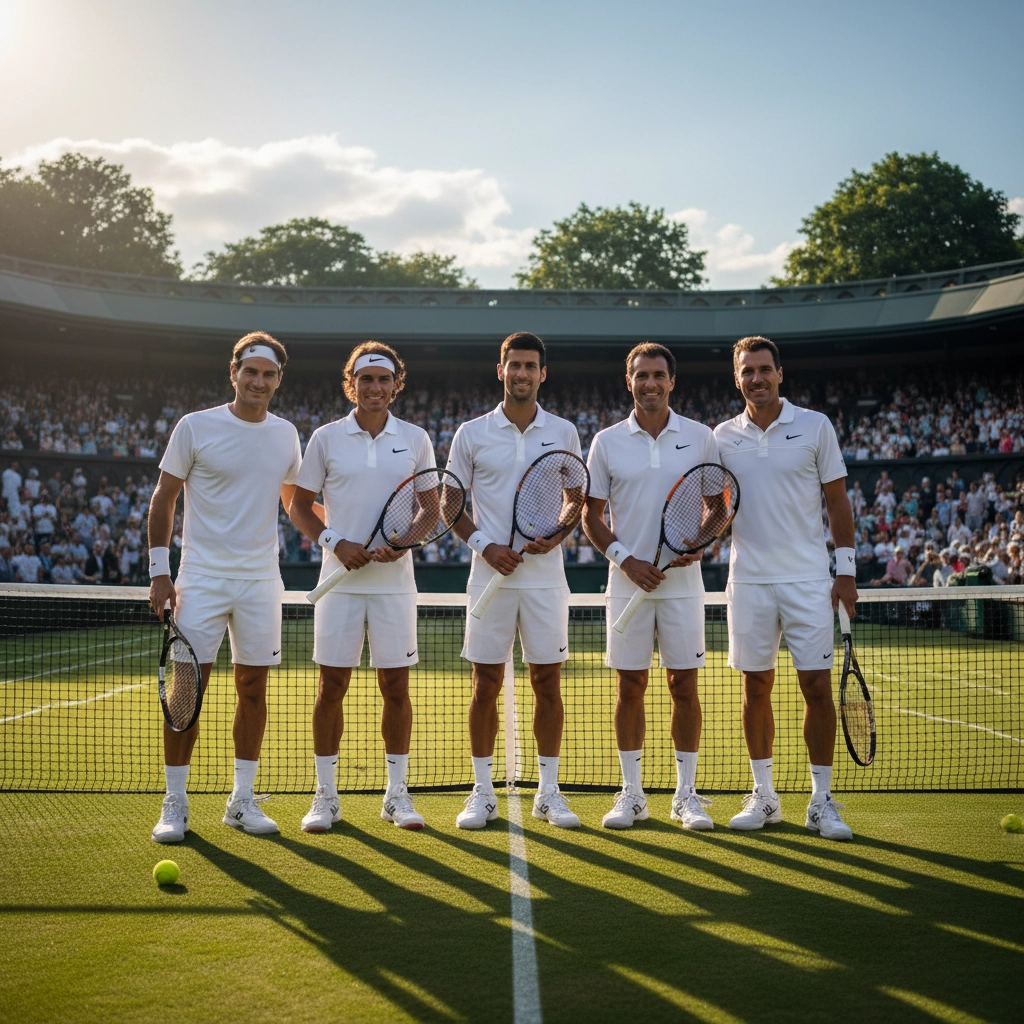
When people talk about modern men’s tennis, they most often mean Roger Federer, Rafael Nadal, and Novak Djokovic — the trio whose overlapping careers produced rivalries and records that reshaped public expectations of greatness. What sets them apart is not just the accumulation of Grand Slam titles but the combination of contrasting styles, sustained dominance, and a string of defining matches that became benchmarks for excellence.
Federer brought an aesthetic standard: fluid footwork, a one-handed backhand that could be both offensive and graceful, and an attacking game that looked effortless even under pressure. Nadal introduced a physical, top-spin-heavy approach that transformed baseline play, turning clay-court mastery into one of sport’s most enduring narratives. Djokovic married exceptional defensive movement and return-of-serve proficiency with relentless consistency, becoming the archetype of a modern, all-surface champion.
Their rivalries produced moments that entered the sporting canon — long, tactical finals on every surface, five-set epics that tested mental resilience, and tournament runs in which one player’s comeback or surge redefined a season. Beyond headline matches, the Big Three pushed each other to innovate: better conditioning programs, more nuanced tactical planning, and new psychological approaches to longevity. Those shifts influenced coaching, scheduling, and how younger players prepared for peak matches.
Importantly, their impact extended off the court. Collectively they elevated the sport’s global profile, drove prize-money growth, attracted sponsors, and helped tennis reach new television audiences. Their presence at the biggest events turned tournament finals into global appointments, and their differing personalities — the elegant baseline artist, the relentless competitor, the stoic tactician — gave fans distinct identities to follow, fueling debates about the “greatest of all time” that mix statistics with subjective measures of style and influence.
Rivals, specialists, and the depth that defined an era
While the Big Three occupied the brightest spotlight, the era’s depth was defined by challengers who produced unforgettable upsets, earned major titles, and forced stylistic evolution. Players like Andy Murray combined tactical intelligence and defensive skill to win multiple majors and to consistently trouble the top three; Stan Wawrinka and Juan Martín del Potro delivered explosive power on the biggest stages to claim landmark Grand Slam victories. Daniil Medvedev, Dominic Thiem, and Alexander Zverev signaled the transition to a new generation with athleticism and heavy baseline weapons capable of toppling any favorite on a given week.
Surface specialists and tactical outliers also kept the era fascinating. Clay-court opponents found ways to disrupt Nadal’s rhythm, big servers and aggressive hard-court players interrupted Djokovic’s runs, and grass specialists staged brief resurgences that reminded observers how surface still matters. These intermittent challengers turned what might otherwise have been a procession into an era of high-stakes chess: matchups required bespoke game plans, and coaches became central architects of tournament strategy.
That competitive depth mattered for legacy. A champion’s achievements gained luster when accomplished against a field that included multiple Slam winners, top-ranked rivals, and players capable of peaking at Grand Slams. The result was a golden, if fiercely contested, period in men’s tennis: one in which records were broken but each new milestone earned its significance through constant, high-quality opposition. In the next part, we’ll examine individual careers and signature matches that best illustrate these dynamics.

Where legends lead next
Legends do more than fill record books; they change expectations, inspire new techniques, and keep conversations about greatness alive across generations. As equipment, training, and global participation evolve, the benchmarks of excellence will too — but the traits that define a true tennis legend (resilience, innovation, and the capacity for defining moments) remain the same. If you want to follow how today’s stars build their own legacies or study match histories and rankings, the ATP Tour is a useful starting point for current results and player profiles.
Frequently Asked Questions
What makes a male tennis player a “legend” beyond Grand Slam counts?
Beyond titles, legendary status comes from long-term excellence, influence on playing style or tactics, memorable head-to-head moments, versatility across surfaces, and cultural impact—how a player changes perceptions of the sport or inspires future generations.
Who are the “Big Three” and why are they central to modern tennis history?
Roger Federer, Rafael Nadal, and Novak Djokovic are the Big Three. They are central because of their sustained dominance, contrasting styles that pushed the sport’s tactical and physical boundaries, and high-profile rivalries that produced many of the era’s defining matches.
How do surface specialists and rival generations affect how we judge greatness?
Surface specialists and transitional generations add depth and context: beating a dominant player on their best surface or succeeding during a particularly competitive era can elevate a player’s achievements. Evaluating greatness therefore requires considering opponents, surfaces, and the overall strength of the field at the time.