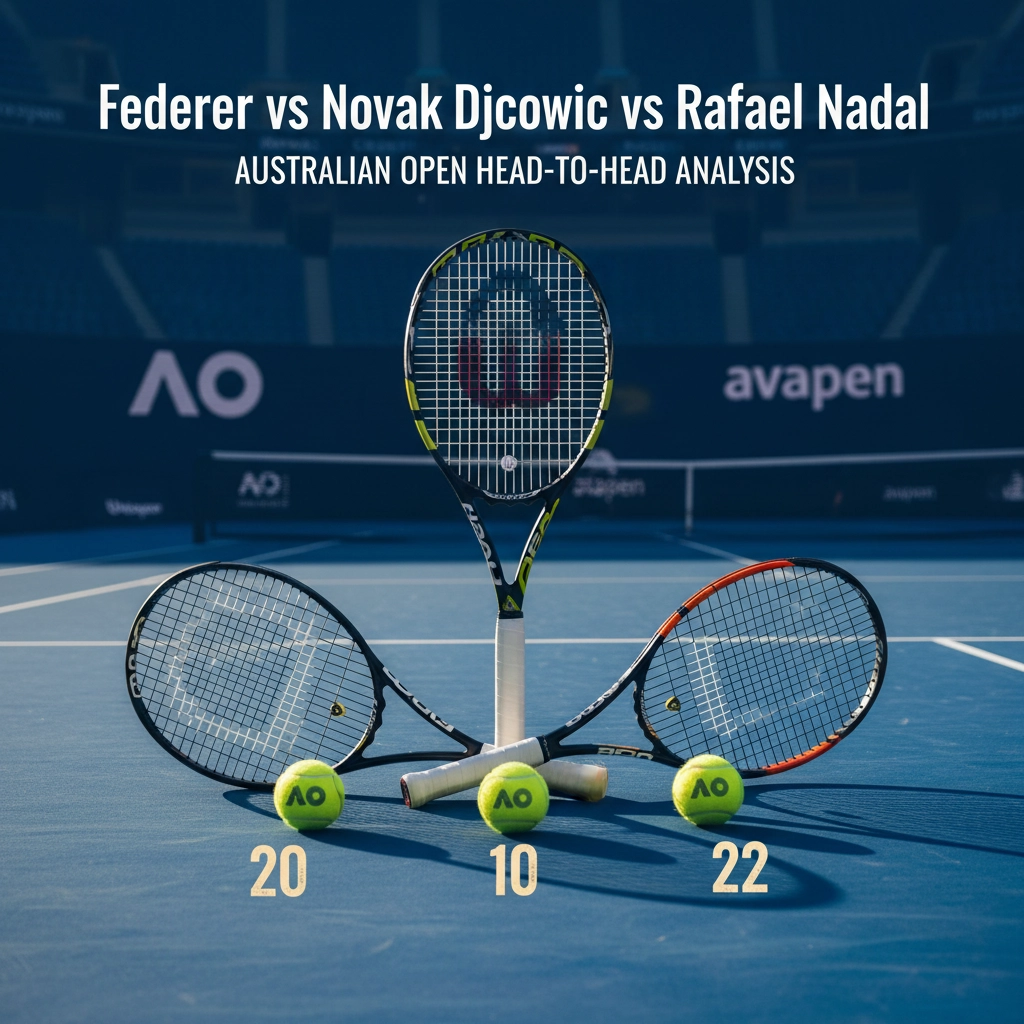

How the Australian Open Became a Stage for Tennis Greats
You already know the Australian Open as one of tennis’s four Grand Slams, but you might not fully appreciate how Melbourne Park has shaped the careers of some of the sport’s most iconic figures. The hard courts, the heat, the late-January slot in the calendar and the fast, raucous atmosphere combine to test physical preparation, tactical flexibility and mental resilience. For players like Roger Federer, Novak Djokovic and Rafael Nadan, the tournament didn’t just offer trophies — it became a proving ground where you could see the evolution of style, stamina and psychological edge.
When you look back at the early 2000s and 2010s, the Australian Open emerges as the place where these three champions often reset expectations for a season. Each arrived with different strengths: Federer’s elegant offense, Djokovic’s defensive mastery and Nadal’s relentless intensity. Understanding their early interactions with Melbourne Park helps you trace the development of epic rivalries and recurring match themes that defined a generation.
Early Australian Open Chapters for Federer, Djokovic and Rafael Nadan
Roger Federer: From Breakthrough to Consistent Contender
You can track Federer’s early Australian Open story as a steady climb. Initially, his grace and attacking tennis made him an immediate threat on the hard courts; he combined a versatile serve with a one-handed backhand that rewarded aggressive positioning. By the mid-2000s, Federer was already converting that potential into consistent deep runs.
- Early results: steady improvement in results and increasing tactical variety.
- Playing identity: you can observe how his offense adapted to hard-court bounce and faster surfaces.
- Milestone matches: key Melbourne wins signaled his readiness to dominate multiple surfaces.
Novak Djokovic: The Australian Open as a Home Away from Home
For Djokovic, the Australian Open quickly became a place where his game — characterized by exceptional movement, flexible defense and precise return of serve — flourished. You’ll notice that the tournament’s conditions amplified his strengths: the slightly slower Plexicushion/GreenSet surfaces rewarded his ability to neutralize opponents and extend rallies until openings appeared.
- Early pattern: steady improvement in return games and baseline control.
- Psychological edge: you can see Djokovic building confidence in Melbourne that translated into multiple title runs.
- Adaptation: improvements in physical conditioning and tactical discipline were evident early on.
Rafael Nadan: Hard-Court Tests for a Clay-Court Titan
Although Rafael Nadan became synonymous with clay, the Australian Open offered him crucial tests that helped broaden his game. You’ll observe how he adapted his heavy-topspin forehand and fierce court coverage to the harder, lower-bouncing courts of Melbourne. Early appearances there revealed both challenges and breakthroughs that contributed to his all-court maturation.
- Transitional focus: adapting topspin-heavy patterns to a quicker surface.
- Key lessons: building a stronger serve and flattening shots when necessary.
- Early impact: moments at Melbourne signaled his capacity to contend across surfaces.
With these early chapters sketched, you’re ready to move into a closer examination of the defining matches, head-to-head showdowns and pivotal finals that truly forged their Australian Open legacies.
Defining Melbourne Showdowns: Matches That Redrew Expectations
You can point to a handful of Australian Open encounters that didn’t just decide a trophy but altered public perception about who each player was and how they would shape the next decade. In Melbourne, momentum shifts often came in the form of long, grinding encounters where the margins were measured in a few points rather than entire sets. These matches revealed new layers in each champion’s game.
– For Federer, the defining Melbourne moments were ones that showcased his shot-making under pressure — sudden forays to the net after a long baseline exchange, or a clutch forehand down the line that changed the tone of a comeback. These wins helped cement the idea that his artistry could be matched by resilience.
– For Djokovic, the Australian Open produced signature matches that highlighted his return-of-serve as an offensive weapon. You might recall occasions where he neutralised big servers, then stretched rallies into opportunities for decisive counterattacks. Those matches convinced many that Djokovic’s baseline retrieval and timing made him uniquely suited to Melbourne’s rhythm.
– For Rafael Nadan, the most telling Melbourne tests were his adaptations: flattening his forehand when needed, sharpening the first serve, and turning defensive scrambles into sudden offensive bursts. Even in losses, his tenacity forced opponents to rethink patterns that had worked against clay-court specialists.
These showdowns did more than hand out trophies — they reconfigured strategies elsewhere on tour. Opponents who thought they could shorten points against Federer learned they had to stay honest from the first ball. Those who tried to overpower Djokovic discovered the costs of giving him extended rallies. And players facing Nadal at Melbourne realised the top-spin-heavy script could be rewritten on a quicker surface.
Head-to-Head Dynamics: Rivalries Forged Under Melbourne Skies
When you watch their matchups in Melbourne across years, a few recurring themes emerge that define these rivalries more than raw statistics.
– Classic contrast: Federer’s measured offense versus Djokovic’s retrieval and Nadal’s topspin warfare. Melbourne turned these contrasts into chess matches where timing and surface adjustments mattered more than raw power.
– Momentum and psychology: The Australian Open’s early-season placement meant that psychological edges often had outsized effects. A confidence-boosting win in January could set the tone for an entire season. Consequently, clutch moments in Melbourne — a break saved at 4–4, a comeback set won in a tiebreak — often shaped how the trio approached subsequent meetings.
– Tactical evolution: Repeated matchups at the Open forced tactical shifts. Federer refined his backhand depth and selective aggression, Djokovic became savvier about when to counterpunch and when to dictate, and Nadan worked on flattening and shortening points when conditions demanded it.
These dynamics are less about one player always overpowering another and more about small, repeatable advantages — an improved return percentage, a tactical variation on serve, a mental edge in extended matches — that accumulated over time.
How Pivotal Finals Reshaped Their Playing Identities
Finals in Melbourne often acted like crucibles: win and you gain belief; lose and you return to the drawing board. For each player, specific final appearances triggered technical and mental adjustments.
– Federer’s finals encouraged greater variety — mixing slices and net approaches with his baseline aggression — so he could finish points earlier on faster days.
– Djokovic’s victorious runs reinforced a philosophy centered on endurance and precision, prompting him to sharpen conditioning and the mental routines that let him reset between points.
– Nadan’s experiences in Melbourne finals and deep runs taught him to supplement his heavy topspin with punchier flattened drives and a more aggressive first-serve strategy to avoid being pinned back.
In short, Melbourne didn’t simply hand out trophies; it forced evolution. Watching how each champion responded to pressure in finals gives you a clearer sense of why their games, and their legacies, matured the way they did.
Melbourne’s Enduring Echoes
Those duels beneath Melbourne Park’s lights did more than decide trophies — they created moments that reverberate through how the game is played, coached and watched. Beyond the technical adjustments and tactical innovations, what lingers is the example these champions set: how preparation, adaptability and a willingness to evolve can prolong excellence. The Australian Open remains, for players and fans alike, a proving ground where narratives are tested and new chapters begin.
For readers who want to revisit the matches and milestones that shaped these legacies, the tournament archives and highlight reels provide a vivid reminder of why Melbourne plays such a pivotal role in modern tennis — see the official site for match histories and features: Australian Open.
Frequently Asked Questions
Which Australian Open matches best illustrated the contrasts between Federer, Djokovic and Nadal?
Key Melbourne encounters highlighted their distinct strengths: Federer’s shot-making and net play under pressure, Djokovic’s offensive returns and retrievals, and Nadal’s adaptations—flattened drives and improved serve—to succeed on a faster surface. These matches often featured tight margins and tactical shifts that revealed each player’s evolving approach.
Why does the Australian Open often shape the season-long momentum for these players?
As the first Grand Slam of the year, Melbourne offers early psychological advantages. A strong performance in January can boost confidence and set tactical directions, while close losses prompt targeted adjustments; both outcomes frequently influence training and match strategies throughout the season.
How have Melbourne battles between these champions influenced younger players?
Their duels showcased the value of adaptability, fitness and mental resilience. Young players and coaches study those matches for lessons on shot selection, point construction and recovery routines, leading to a broader trend of blending aggressive shot-making with disciplined defense across the next generation.