Many elements define Roland-Garros’ identity: the slow, high‑bouncing clay surface extends rallies, rewards topspin and endurance, and reshapes tactics; its forgiving slide creates dramatic angles but also poses real injury risks to ankles and knees; the result is a tournament that elevates patience, strategy, and physical resilience, producing epic, momentum‑shifting matches and unexpected upsets that set the French Open apart.
Understanding Clay Courts
Clay courts slow pace and amplify topspin, producing higher bounces and extended rallies-conditions that favor baseline grinders and left-handers who can generate heavy spin. Tournament red clay, like Roland Garros, often reduces effective serve speed and increases break-point frequency, shifting tactics toward patience and point construction. Maintenance, moisture and particle grade create daily variability that rewards adaptive footwork and slide technique.
Types of Clay Courts
European red clay (calcined brick) is the Roland Garros standard, while American green clay (Har-Tru) uses metabasalt for a firmer, faster feel; particle size, binder and base affect skid and absorption. Tournament organizers adjust watering and rolling to tune speed and bounce. The differences change ball speed, bounce height and sliding behavior.
- Red clay – slowest, high bounce, ideal for heavy topspin specialists
- Green clay – firmer, quicker bounce, often used in U.S. spring events
- Crushed brick – common European variant with fine particle profile
- Synthetic clay – engineered for consistency and lower maintenance
| Surface Type | Typical Play Characteristics |
| Red clay (calcined brick) | Very slow, high bounce, promotes long rallies and heavy topspin |
| Green clay (Har-Tru) | Firmer underfoot, plays ~10-20% faster than red clay |
| Crushed brick variants | Variable grain size; tournament-specific rolling/watering alters speed |
| Synthetic/artificial clay | Designed for consistency, less weather sensitivity, quicker drying |
Unique Characteristics of Clay
Clay rewards heavy topspin and endurance: points routinely last several shots longer than on hard courts, and lateral sliding changes movement dynamics, increasing strain on ankles and knees. Matches at Roland Garros often devalue pure serve power and amplify return games; Rafael Nadal’s dominance-14 French Open titles-illustrates how spin and movement mastery translate to success.
Sliding creates specific biomechanical demands: players generate force while decelerating into a slide and rehabbing into recovery steps, which elevates risk of sprains but also reduces direct impact from stops; coaches emphasize eccentric strength and hip stability for prevention. Clay’s moisture sensitivity means routine morning watering can slow play markedly, while afternoon sun can quicken the court-tactical teams track hourly conditions and adapt string tension, footwear studs and point construction accordingly to exploit or mitigate those shifts.
Factors Influencing Gameplay
On clay the interplay of surface friction, ball behavior and player movement shapes tactics: slower pace amplifies spin and rewards consistency, while soft footing favors sliding and reduces pure serve dominance. Coaches cite that rallies average roughly 5-6 shots on clay versus 3-4 on faster surfaces, shifting emphasis to point construction and recovery. Perceiving how these elements interact allows players to prioritize endurance, slide-technique and topspin generation for success at Roland Garros.
- clay courts
- ball bounce
- spin
- sliding
- endurance
Ball Bounce and Spin
Clay increases friction, producing a higher, slower bounce and magnifying topspin: pros often rely on heavy RPMs to push opponents behind the baseline and open angles; Nadal’s forehand is the canonical example. Tournaments show more kick serves and bounding responses, so depth and net clearance become tactical priorities while the low skid that benefits flat hitters on grass is largely absent on clay.
Player Movement and Endurance
Sliding is central-players must execute controlled slides to recover position while limiting joint strain, because eccentric loading on quads and hips increases fatigue and microtrauma. Longer rallies and denser point construction frequently push late-round matches past three hours, so superior aerobic capacity, repeated-sprint ability and rapid recovery between points separate the fittest contenders.
Sports science teams track load: competitors typically cover 3-6 km per match on clay with elevated lateral decelerations, prompting programs that emphasize eccentric strength (Nordic curls, eccentric squats), hip mobility and on-court slide drills 2-3 times weekly. Practical measures-interval pacing, targeted nutrition, ice baths and compression-help manage inflammation and preserve sprint power across multi-hour contests.
Tips for Playing on Clay
Adapt footwork to clay courts by mastering controlled sliding and shorter, quicker recovery steps; favor heavy, high-bouncing shots to push opponents back and exploit slow surface reaction; vary spin and depth to prevent predictable patterns at the French Open. Any practice block should include sliding drills, high-topspin feeding, long-rally endurance work, and targeted drop-shot execution.
- Slide into every split step to maintain balance and prepare for low, skidding balls.
- Topspin forehands force higher bounces and open angles-use them as primary weapons.
- Slice backhands change rhythm and reduce opponent attack opportunities.
- Drop shots are more effective because baseline depth is greater on clay.
- Point construction should prioritize patience, depth, and creating openings rather than quick winners.
Strategy and Shot Selection
Favor heavy, loopy topspin to exploit the high bounce and force opponents behind the baseline; mix deep crosscourt drives with angled short balls to open the court. Use the slice to alter pace-Bjorn Borg and Rafael Nadal used it to reset rallies-and employ the drop-shot after securing deep, heavy balls; approach on a short ball only when the opponent is off-balance, and prefer inside-out forehand patterns to finish points.
Mental Preparation
Anticipate longer rallies and multi-hour matches at the French Open, so build process goals like winning 10 of 15 extended rallies and rehearsing focused breathing between points; break matches into sets and micro-goals to manage endurance and concentration. Use visualization of sliding recovery and scenario drills to maintain calm under momentum shifts.
Develop routines that anchor attention: pre-serve cues, two deep breaths after changeovers, and objective timers for towel breaks. Track small metrics-first-serve percentage on clay, forced-error ratio, success on short-ball approaches-to adjust tactics mid-match. Study case examples: Nadal’s relentless point construction and set-by-set intensity show how micro-goals and ritualized focus translate into sustained dominance on clay courts.
Pros and Cons of Clay Courts
| Pros | Cons |
| Slower surface that extends rallies and rewards construction of points. | Serves and quick winners are less effective, reducing free points. |
| Higher, more predictable bounce that benefits heavy topspin hitters. | Low slices and skids are less effective; net play is diminished. |
| Favors endurance and tactical depth-baseline grinders thrive (e.g., Nadal). | Matches commonly last longer, increasing cumulative fatigue. |
| Sliding allows recovery and defensive retrievals when executed well. | Sliding raises risk of ankle and knee strain if technique or footing fails. |
| Levels the field for returners; break-of-serve rates rise. | Big servers and flat hitters face a strategic disadvantage. |
| Enables varied shot selection: drop shots, heavy angles, topspin lobs. | Court maintenance is intensive; rain turns courts unplayable quickly. |
| Historic character and unique spectacle that define Roland Garros. | Scheduling is more vulnerable to weather, causing pile-ups during slams. |
| Promotes longer careers for some tactical players who avoid blistering pace. | Consistent clay season specialists may struggle on faster surfaces. |
Advantages for Players
Clay’s slower pace and higher bounce reward heavy topspin, patience and footwork, which is why Rafael Nadal has amassed 14 Roland Garros titles. Matches favor grinders-rallies frequently extend to 6-12 shots-so players with superior endurance, sliding technique and point construction (examples: Gustavo Kuerten, long-career baseliners) can neutralize raw power and exploit tactical variety.
Disadvantages for Players
Longer rallies and frequent sliding increase match length and cumulative strain, making recovery tougher between rounds; as a result, injury risk and longer recovery time rise, and big servers or net-rushers see their weapons blunted.
Sliding stresses the lower limbs-players often report more ankle sprains, patellar irritation and tendon overload compared with hard courts-and daily maintenance plus rain can force schedule compression at Roland Garros, so athletes must manage workload, physiotherapy and often take an extra 24-48 hours of recovery to avoid form and fitness decline.
Step-by-Step Guide to Preparing for the French Open
Begin scheduling 8-6 weeks of clay-specific preparation: build endurance, lower string tension ~2-4 lbs for more dwell and spin, and add daily sliding drills. Allocate 4-2 weeks to sharpen topspin, kick serves and match-simulations on red clay, then a 5-7 day taper with short, high-intensity sessions. Use examples like Nadal’s heavy forehand topspin focus and simulated 3-set matches to adapt to slower bounce and higher ball flight; prioritize injury prevention for ankles and knees.
| Phase | Key Actions |
|---|---|
| 8-6 weeks | Interval endurance (3×/week), sliding technique drills (30-45 min), progressive load on lower body |
| 4-2 weeks | Clay tactical sessions, topspin serve/kick practice, match-simulation (3×/week), lower string tension by 2-4 lbs |
| 1 week | Taper volume, maintain intensity, short on-court reps, final equipment checks (shoes, strings) |
| Clay drills | Drop-step sliding, crosscourt rally emphasis, high-bounce forehand drills, 10-15 minute sliding progressions |
| Recovery & nutrition | Sleep 8-9 hrs, ice baths 10-15 min post-session, hydrate with electrolytes, targeted carb/protein timing |
Training Focus Areas
Emphasize sliding mechanics, heavy topspin development and aerobic capacity: perform sliding drills 3× weekly (30-45 minutes), combine with 10×20m sprint intervals and 20-30 minute threshold runs twice weekly. Allocate specific sessions to point construction on clay-practice kick serves, angled returns and long crosscourt rallies with 70-80% rally length >8 shots to simulate real match demands.
Nutrition and Recovery
Hydrate with 5-10 ml/kg 2-4 hours before play and target 30-60 g carbohydrates per hour during matches lasting up to 2.5 hours; for prolonged play increase toward 60-90 g/h. Use ice baths (10-15 min), compression and 8-9 hours sleep for recovery, and monitor sodium losses on hot days to avoid hyponatremia. Adequate on-court fueling prevents performance drop.
For practical intake: eat a pre-match meal 3-4 hours prior with 60-90 g carbs (e.g., 2 cups cooked pasta + lean protein), during matches take gels or drinks to hit 30-60 g carbs/hour, and post-match consume 1.0-1.2 g/kg carbs within 2 hours plus 20-30 g protein for glycogen restoration-an 80 kg player needs ~80-96 g carbs. Include omega-3s and tart cherry for inflammation control and use compression and active recovery the day after intense sessions.
The Role of Weather
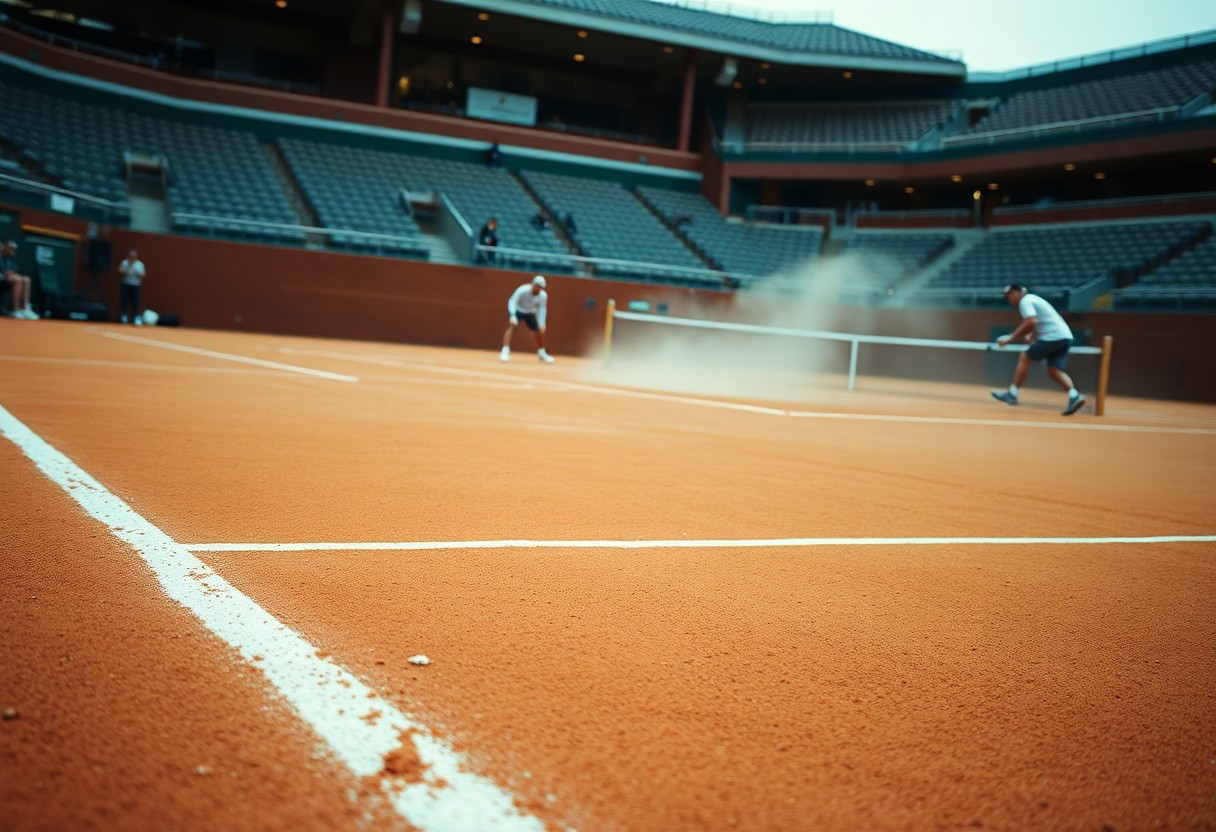
Parisian weather in late May-early June (average temperatures roughly 12-25°C and about 50 mm of May rainfall) turns Roland‑Garros into a shifting playing field: damp days make courts heavy with lower, slower bounces, while dry, warm stretches yield faster, skidding conditions and dust clouds. The 2020 addition of a retractable roof on Philippe‑Chatrier reduced scheduling chaos, but most practice courts remain exposed, so conditions still alter match dynamics daily.
Impact of Conditions on Play
Humidity and rain directly change ball behavior and footing: wet clay reduces skid and lowers bounce, extending rallies by roughly 1-3 shots compared with hard courts and decreasing serve effectiveness, which raises break‑point frequency. Footwork becomes paramount because sliding becomes more unpredictable on damp days, increasing strain on ankles and knees; Nadal’s ability to convert topspin into court positioning illustrates how weather amplifies tactical demands.
Adaptability Strategies
Top players respond with technical, equipment, and tactical shifts: adopting more topspin (often >3,000 rpm on heavy hitters), using grippier clay shoes, loosening string setups slightly for more bite, and constructing points patiently with heavy kick serves and angled forehands. Coaches schedule extra slide drills and longer endurance sessions during the fortnight to prepare players for the extended rallies and variable footing that define clay tennis.
Practically, teams measure conditions each morning-testing ball bounce on center court and adjusting string tension or shoe choice accordingly-and run targeted routines: 10-15 minutes of controlled sliding practice, 20-30 minutes of high‑spin serve reps, then simulated long‑rally sets to build recovery patterns. Match plans often call for more second‑serve kick placement and selective net approaches to exploit opponents struggling with the unstable surface after rain.
To wrap up
Considering all points, the French Open’s clay transforms ball behavior, favors endurance and tactical variety, and tests movement and shot selection in ways hard courts and grass do not, producing distinctive match rhythms, specialized champions, and strategic depth that make Roland-Garros the most unique Grand Slam on tour.
FAQ
Q: How do the physical characteristics of clay courts make the French Open play differently from the other Grand Slams?
A: Clay is the slowest of the major surfaces and produces a higher, more abrasive bounce that shortens the effective speed of shots and rewards heavy topspin. Balls lose pace on impact, which prolongs rallies and reduces the advantage of purely flat, power-based weapons – serves and winners become harder to finish. The surface also allows players to slide into shots, altering footwork and recovery patterns and increasing the emphasis on balance, anticipation and constructed point-building rather than quick point-ending aggression.
Q: What tactical and equipment adjustments do players make specifically for the French Open?
A: Players shift tactics toward spin, patience and positioning: they use heavier topspin to push opponents back, target angles and change depth to open the court, and choose to grind out points rather than rush net approaches. Return-of-serve becomes more central, break opportunities rise, and shot selection favors consistency and margin over sheer power. Equipment and setup are adapted too-string choices and tensions may be tweaked for more bite and spin, and players wear clay-specific shoes with tread optimized for controlled sliding; recovery, fitness and on-court movement are prioritized in training to handle the long, attritional exchanges typical at Roland Garros.
Q: In what ways do weather and court maintenance add to the French Open’s uniqueness?
A: Clay is highly weather-dependent: damp conditions make the court heavier and slower, dry spells make it faster and more unpredictable. Tournament staff constantly groom, water and roller the courts between matches, so conditions can subtly change day to day or even session to session, affecting bounce and footing. Clay also visibly marks the ball impact, which has long influenced umpiring and dispute resolution. Those variables – shifting speed, visible ball marks, red-stained clothing and the need for continual tactical adaptation – combine to create a playing environment and spectator atmosphere unlike any other Grand Slam.