Most historians single out a handful of legendary champions whose clay-court mastery-from Rafael Nadal’s unrivaled dominance and tactical topspin to Björn Borg’s ice-cold baseline precision and Chris Evert’s relentless consistency-shaped Roland Garros, illustrating how endurance, strategy and surface-specific technique create enduring sporting legacies.
The Origins of Roland Garros
Established in 1891 as the Championnats de France, the event remained largely domestic until it embraced international competition in 1925. Played on distinctive red clay, the tournament settled at the purpose-built stadium named for aviator Roland Garros in 1928, a move that solidified its Paris identity and the slow-court, endurance-driven tennis that defines its legacy.
Historical Background
Entry was restricted to French club members until the federation opened the draw in 1925, immediately producing global stars like René Lacoste and Suzanne Lenglen. The 1928 stadium, erected for a Davis Cup tie, gave the event permanent clay courts and increased capacity, enabling steady international growth throughout the interwar years and beyond.
Evolution of the Tournament
The advent of the Open Era in 1968 allowed professionals to compete, standardized a 128-player singles draw and accelerated prize-money and broadcast expansion. Subsequent infrastructure investments – notably the Philippe-Chatrier renovation and the retractable roof completed in 2020 – modernized scheduling and global TV exposure.
Technical and organizational changes reshaped play: refined court maintenance, ball technology and season timing rewarded heavy topspin and stamina, producing specialists such as Björn Borg (six French titles) and Rafael Nadal’s 14 Roland Garros crowns. Those shifts turned a national championship into one of tennis’s four major events with worldwide reach.
Legendary Male Players
At the heart of Roland Garros history stand men whose clay mastery rewrote tactics and records: Rafael Nadal with an unparalleled string of titles and relentless topspin, and Björn Borg whose icy baseline control yielded six crowns. Both combined extraordinary endurance, tactical nuance and mental fortitude to dominate long rallies, forcing opponents into movement errors and reshaping coaching priorities for clay specialists worldwide.
Rafael Nadal: The King of Clay
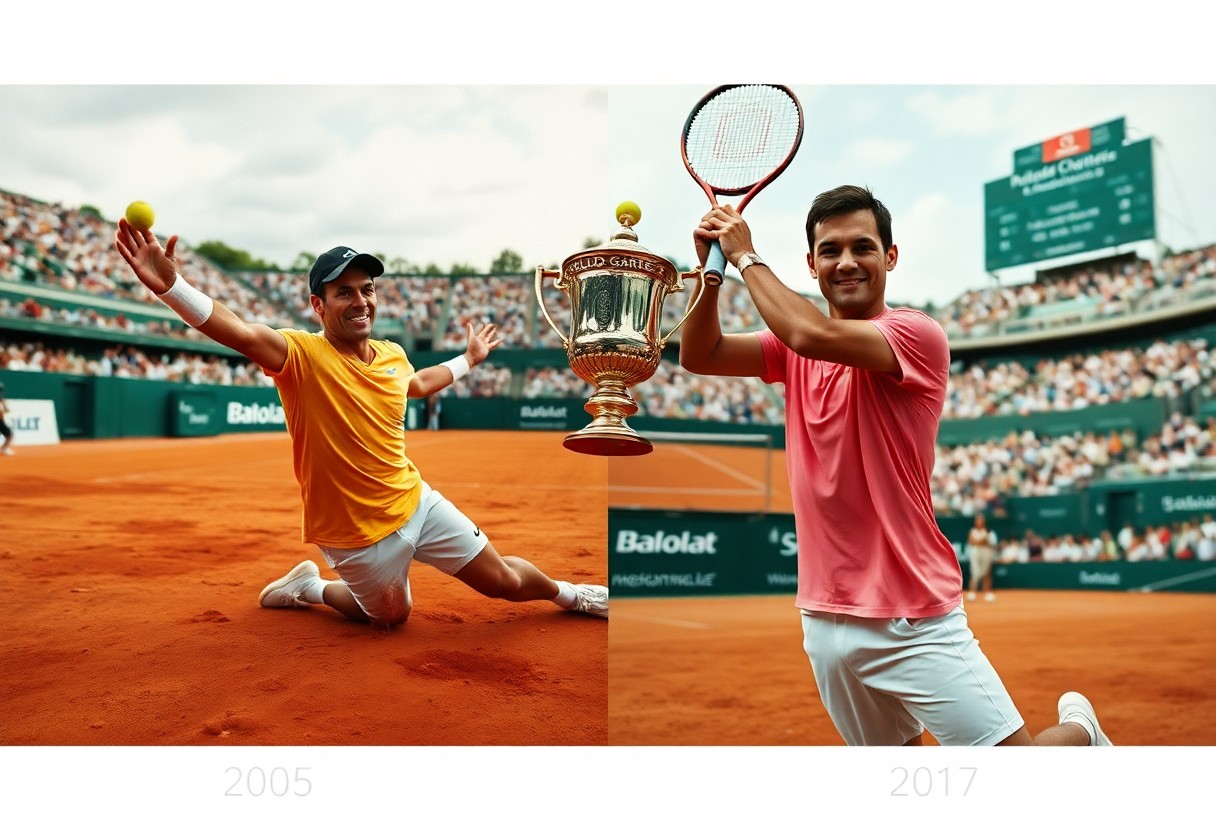
Since his 2005 breakthrough, Nadal has amassed 14 Roland Garros titles, pairing an explosive forehand heavy on topspin with surgical footwork and a punishing kick serve. He turned defense into offense with unparalleled court coverage, delivered signature wins in finals against Federer (2008) and Djokovic (2014), and maintained an extraordinary clay win-rate that defines his legacy.
Björn Borg: The Unbeatable Force
Borg combined ice-cold concentration with relentless baseline depth to capture six French Open titles between 1974 and 1981, setting the modern clay template: relentless consistency, exceptional stamina and the ability to neutralize power through precision. His era-defining matches forced opponents into long error-prone exchanges and influenced generations of counterpunchers.
Six titles (1974, 1975, 1978, 1979, 1980, 1981) came from Borg’s unique rhythm control-deep, penetrating groundstrokes, acute court positioning and a refusal to rush points. He excelled at extending rallies until opponents’ timing broke, then shifted pace to create angles; coaches still cite his match management and physical conditioning as a masterclass in clay-court dominance.
Legendary Female Players
Across different eras, women forged clay dynasties by mixing endurance, spin and tactical nuance: Serena Williams brought power and 3 Roland Garros singles crowns to an era of athleticism, while Chris Evert set the standard with 7 French Open titles and a historic 125-match winning streak on clay, exemplifying relentless baseline precision.
Serena Williams: The Modern Dominator
Serena combined a booming serve, ferocious return and uncompromising court cover to amass 23 Grand Slam singles and 3 Roland Garros titles (2002, 2013, 2015); key victories over top rivals and late-career runs demonstrated her ability to convert raw power into disciplined clay-court strategy.
Chris Evert: The Clay Court Queen
Evert’s game was built on surgical depth, exceptional footwork and shot tolerance, translating into 7 French Open titles and a remarkable 125-match clay winning streak, a record that underlines her psychological steadiness and unmatched consistency on slow surfaces.
Her seven Roland Garros triumphs came in 1974, 1975, 1979, 1980, 1983, 1985 and 1986, each campaign featuring controlled topspin, angle construction and an ability to extend rallies until opponents erred; those title runs became the blueprint for modern clay specialists looking to combine patience with precise offense.
Unforgettable Matches in Roland Garros History
Tennis at Roland Garros has served up marathon finals, seismic upsets and defining career moments: Rafael Nadal’s 14 titles underpin decades of clay dominance, while landmark matches – from sudden four-set shocks to five-set comebacks – shaped tennis narratives and rankings with lasting effect.
Epic Finals
Several finals stand apart: the recurring Nadal-Federer clashes on clay, Nadal’s domination across the 2000s and 2010s, and Gustavo Kuerten’s 1997 breakthrough, which launched a clay-court legacy. Spectators still cite the tactical depth, momentum swings and endurance tests that made those championship matches defining moments for both players and the tournament.
Shock Upsets
Unexpected knockouts reshaped draws: Robin Söderling’s 2009 victory over Rafael Nadal ended Nadal’s unbeaten run at Roland Garros and opened the draw, while Gaston Gaudio’s 2004 comeback – sealing the title after saving match point – remains one of the tournament’s most dramatic reversals.
Digging deeper, Söderling’s 2009 fourth-round win was the first time Nadal lost a main-draw match at Roland Garros; Söderling then rode that momentum to the final, where Federer claimed his only French crown. Gaudio’s 2004 final saw him overturn a heavy favorite in Guillermo Coria, converting a match point and demonstrating how mental resilience and clay-court craft can topple form books and seeds alike.
The Impact of Clay Court on Player Development
Clay forces development toward tactical patience and physical resilience; players learn to win points through construction rather than outright power. Training on clay promotes heavy topspin, superior court coverage and extended rally tolerance-traits exemplified by Rafael Nadal’s 14 Roland Garros titles. It also exposes weaknesses: serve-dependent games often suffer, while grinders and counterpunchers flourish. Coaches routinely use clay weeks to improve stamina (many matches exceed three hours), defensive positioning and shot tolerance under variable bounce conditions.
Skills Acquired on Clay
Practicing on clay builds a toolkit of transferable skills: topspin depth, precise angles, sliding footwork and patient point construction that turn defense into offense. Return timing and soft hands for drop shots improve, and players often develop stronger two-handed backhands and improved anticipatory reads. Junior programs on clay report faster gains in endurance and point IQ, with players learning to craft points across 6-12 shot sequences rather than hunting quick winners.
The Unique Challenges of Clay Play
Clay presents inconsistent bounces and slower ball speed that neutralize flat power and reward spin and placement; serve percentages fall and break opportunities rise. Footing demands refined sliding technique, increasing joint stress and risk of slips on damp days. Tactical patience becomes a weapon: players must construct points, change pace and exploit shorter angles while coping with matches that swing momentum over long rallies.
Technically, clay forces adaptations in stroke mechanics and movement: players adopt a more pronounced open stance, earlier racquet preparation and a pronounced low-to-high swing to maximize topspin and kick. Surface conditions change during a tournament-morning dampness yields slower, lower bounces, while dry afternoons produce quicker, higher trajectories-so in-match adjustments and footwear choices (herringbone soles) are game-defining for minimizing slips and sustaining aggressive defense.
Future of Roland Garros
Expect Roland Garros to blend tradition with innovation: the retractable roof over Court Philippe-Chatrier (installed 2020) and improved drainage already cut weather disruption, while ongoing court-chemistry research and soil-management technology aim to standardize bounce across courts. Tournament planners are also balancing calendar pressure and player welfare, shifting warm-up windows and scheduling approaches to limit extreme match-to-match recovery swings without altering the clay identity that defines the event.
Emerging Talents
Players born between 2001-2003 are altering clay tactics: Carlos Alcaraz (b.2003) brings explosive footwork and finishing instinct, Jannik Sinner (b.2001) combines baseline precision with physical resilience, while Holger Rune (b.2003) and Lorenzo Musetti (b.2002) add variety through spin and one-handed artistry. Their rise shows at ATP Masters events and ATP 250/500 clay seasons, forcing established clay specialists to adapt point construction and recovery strategies.
The Role of Technology
Hawk-Eye line systems, advanced broadcast analytics and player wearables are reshaping preparation and officiating; Hawk-Eye and court sensors now feed coaches real-time serve speed, spin and movement data, while stadium investments-like the Chatrier roof-reduce weather variables. Tournament analytics teams use that data to optimize match schedules and medical interventions, making performance and player safety measurable in ways unseen two decades ago.
More granularly, soil-moisture sensors, automated irrigation and ball-tracking feed into predictive models used by grounds crews and coaches: teams monitor moisture levels and adjust watering to maintain consistent bounce, while analytics platforms flag acute workload spikes from GPS and heart-rate data so trainers can intervene. Case in point: data-driven load management during clay swings has become standard for top-20 teams to lower soft-tissue injury risk and preserve peak form for Paris.
FAQ
Q: Who are the greatest champions in Roland Garros history and what records set them apart?
A: Rafael Nadal is the tournament’s defining figure with 14 French Open singles titles, unmatched dominance on clay and a game built around heavy topspin, relentless court coverage and mental grit. Chris Evert holds seven women’s singles titles and is noted for her baseline consistency and unmatched clay-court win percentage. Björn Borg collected six Roland Garros crowns with ice-cool defense and extraordinary endurance during the 1970s-early 1980s. Gustavo Kuerten (three titles: 1997, 2000, 2001) brought flair and tactical variety that helped popularize modern clay-court movement, and Novak Djokovic’s multiple titles illustrate how all-court versatility and return excellence can conquer Paris as well.
Q: What playing traits and skills define a Roland Garros legend?
A: Dominant clay-court players combine heavy, high-bouncing topspin (to push opponents back), superb lateral movement and sliding technique, exceptional stamina for extended rallies, precise point construction and patience, and the ability to open points with angled forehands or kick serves. Tactical intelligence – choosing when to vary pace, hit drop shots or come to the net – plus mental resilience under slow-surface attrition separate consistent champions from one-off winners. Physical conditioning and clay-specific practice routines are standard for those who excel repeatedly in Paris.
Q: Which matches or moments best illustrate mastery of the clay at Roland Garros?
A: Rafael Nadal’s 2005 breakthrough final and his many later finals (including the commanding 2008 win over Roger Federer) showcase raw topspin power, endurance and clay supremacy. Björn Borg’s string of titles in the late 1970s and early 1980s epitomize steady baseline control and ice-cold match temperament. Gustavo Kuerten’s 1997 surprise victory and subsequent titles highlight tactical creativity and charisma on slow courts. Chris Evert’s era-long consistency and multiple finals wins exemplify how unyielding accuracy and point-by-point discipline create sustained success at Roland Garros.