There’s more to Roland Garros than televised match play; behind the scenes teams orchestrate logistics, player care and court preparation. Grounds crews’ clay maintenance dictates ball behavior and scheduling, while tight coordination among hospitality, transport and the media keeps the tournament running. Wet clay and lightning pose notable safety hazards, managed by strict protocols, and dedicated medical and support staff preserve player performance and fan experience.
History of Roland Garros
Tracing its roots to 1891, the French Championships began as a closed national event and, after opening to international competitors in 1925, rapidly transformed into a Grand Slam centerpiece; the creation of the stadium in 1928 and its naming for aviator Roland Garros anchored the tournament’s identity and clay-court legacy amid growing global prestige.
Origins and Evolution
Initially limited to French club members, the event expanded after World War I and produced the legendary Four Musketeers (Lacoste, Cochet, Borotra, Brugnon) who dominated the 1920s; that era’s surge in international interest forced administrative and venue changes, setting the stage for modern professionalization and the tournament’s eventual status as one of tennis’s four majors.
The Development of the Stadium
Built in 1928, the complex grew around the central show court, Philippe Chatrier, later joined by Suzanne Lenglen and Simonne Mathieu; over decades it expanded from simple clay courts to a multi-court facility designed for broadcasters, players, and tens of thousands of spectators.
Recent projects illustrate that evolution: Chatrier’s major overhaul added a retractable roof and modern facilities, finished ahead of the 2020 season, while the 2019 opening of Simonne-Mathieu repurposed historic glasshouses-an engineering feat that also sparked environmental debates over works in the Jardin des Serres d’Auteuil and shaped current capacity and access planning (Chatrier roughly 15,000 seats).
Preparing the Venue
Preparing the site for play begins days ahead: teams of 30-40 groundskeepers work across the tournament’s 20+ competition courts, staging equipment, lighting and seating; staging crews move hundreds of tons of material nightly. Grounds staff perform final inspections and a final roll and watering within 60-90 minutes before first serve to ensure consistent bounce, while operations staff confirm power, broadcast feeds and security lines are live.
Court Maintenance
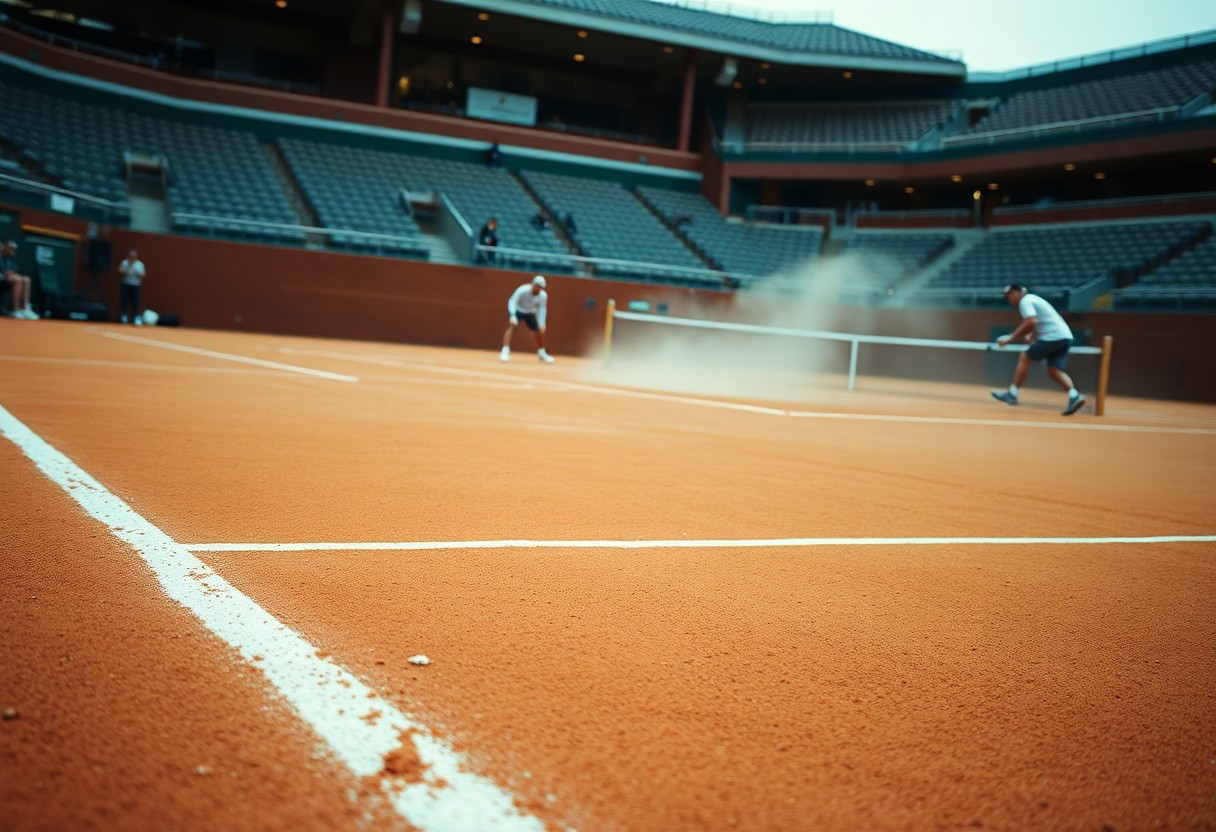
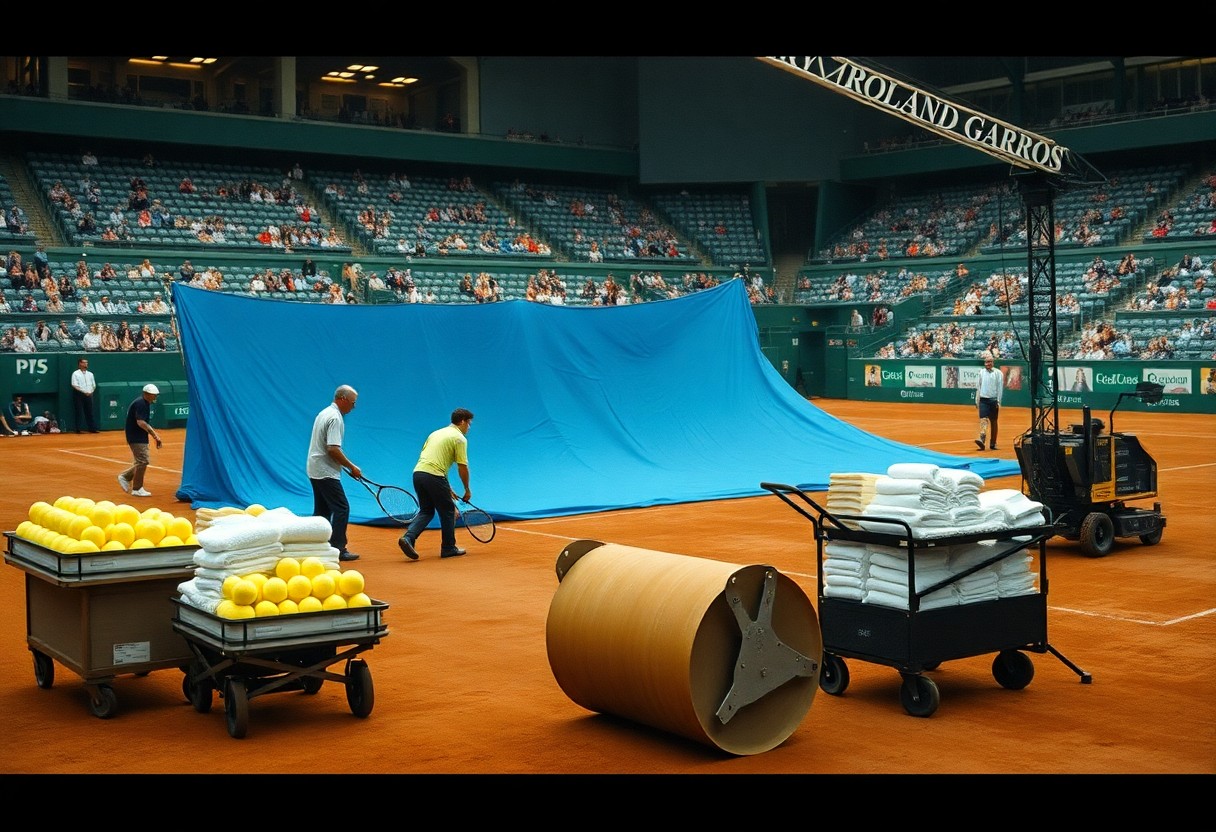
On the clay itself, crews drag, sweep and water the courts several times a day-commonly three scheduled treatments-and use rolling to compact the surface; teams top-dress with crushed brick and loam when needed and monitor moisture with soil probes to target a uniform bounce. Hand-line brushes, mechanical drag mats and a 1.2-ton roller are deployed between sessions, and staff watch for slippery patches after rain, which can force immediate intervention.
Infrastructure Behind the Scenes
Beyond courts, the site runs on a web of systems: the renovated Philippe-Chatrier’s retractable roof (added during 2019-2020 works) and ~15,000-seat capacity are supported by redundant power feeds, backup generators and a dedicated broadcast compound handling dozens of feeds to global networks. Heavy cranes, trucks and forklifts move stage modules and containers-operations where safety risks are actively managed by onsite logistics teams.
Digging deeper, IT teams maintain a redundant fiber backbone and secure Wi-Fi for media and operations, while the electrical team stages mobile substations to protect critical loads; generators can sustain important systems for extended outages. The logistics hub coordinates catering, which serves tens of thousands of meals over the fortnight, and a security control room monitors hundreds of cameras to manage crowd flow and emergency response.
The Role of Staff
Staff keep Roland Garros functional behind the scenes: grounds crew, court managers, broadcast engineers and medical teams coordinate hourly to maintain play. Typically more than 1,200 full-time and seasonal staff handle court resurfacing, ball logistics, heat protocols and player movements, enabling 15,000-seat Philippe-Chatrier match days and the rapid court turnarounds that TV viewers never see.
Organizers and Volunteers
Organizers lock schedules, vendor contracts and broadcast slots while about 1,200 volunteers run accreditation, wayfinding, player liaison and lost-and-found desks. Many undergo multi-day training in languages and emergency procedures; for example, volunteer teams process thousands of spectators per hour at peak entry gates, smoothing flows and resolving onsite issues before they escalate.
Security and Crowd Management
Security combines private stewards, the Police Nationale and emergency services to protect fans and players, using bag checks, metal detectors and sniffer dogs, controlled-access lanes and visible stewarding to manage crowds up to 15,000 in Philippe-Chatrier while keeping ingress/egress and sightlines clear.
On high-attendance days staffing typically rises by 30-50%, putting over 600 officers and stewards on duty; teams use CCTV, dedicated radio networks and a centralized command post to coordinate responses. They rehearse evacuation plans, maintain medical liaison points and operate fast-track lanes for accredited personnel to minimize response times and prevent bottlenecks at known choke points.
Technology and Broadcast
Behind the Camera
More than 20 fixed and roaming cameras cover each Philippe-Chatrier match: baseline, low court-level, rail-mounted sliders and overhead cable-suspended units for dynamic frames. Production teams operate from an OB truck with roughly 60 technicians, switching live feeds, managing RF microphones and synchronizing super-slo-mo units that capture hundreds to thousands of frames per second to freeze racket-to-ball impact for evidence and dramatic replays.
Innovations in Live Coverage
Broadcasters now deliver 4K HDR feeds alongside enhanced graphics powered by Hawk-Eye ball-tracking, showing speed, spin and projected bounce in real time; AI tools auto-generate highlights and tag rallies by intensity, enabling on-air editors to surface key moments within seconds and offering viewers interactive stat overlays during matches.
For example, many rights-holders provide multi-angle OTT streams with up to six simultaneous court feeds and experiment with sub-5-second low-latency playback to align live action and betting markets. Hawk-Eye systems sample ball data at hundreds of times per second, while AI-driven clipping pipelines can produce ready-to-publish highlight packages in under a minute, cutting manual edit time and increasing viewer engagement across platforms.
Fan Experience
Fans experience the tournament across two main showcourts-Philippe-Chatrier (~15,000 capacity) and Suzanne-Lenglen (~10,000)-plus dozens of outer courts, contributing to more than 480,000 spectators over the fortnight. Lines form early: day-session ticket holders often arrive before 10:00, while evening sessions and walk-ups can produce entry waits of 10-20 minutes at security checkpoints. Food stalls, merchandise stands and the Fan Village keep activity buzzing between matches.
Access Areas Unseen by TV
Many spectators never see the players’ back corridors, the accreditation-only mixed zone or the busy media center; instead they catch glimpses on outer practice courts where morning sessions are usually public. Backstage hospitality suites and the TV compound are tightly controlled, with restricted access and routine bag searches. Service roads, equipment trucks and ball-kids’ preparation areas form a logistical maze that keeps televised play seamless.
Fan Interactions and Activities
Official autograph sessions and pop-up meet-and-greets allow fans to meet players and legends in timed slots, often drawing queues of 50-200 people. Sponsor activations-such as Lacoste clinics and interactive clay demonstrations-run daily in the Fan Village, with practical clinics hosting 20-30 participants per session. Long queues and high sun exposure make hydration stations and timed-entry policies important safety measures.
Organizers publish autograph schedules on the Roland‑Garros app and on-site boards; popular sessions use numbered wristbands to prevent surges and keep lines orderly. Volunteers and venue staff coordinate clinic rotations and sponsor activations, while on-site medical tents and misting stations address heat-related issues when May-June temperatures exceed 25-30°C. VIP packages often include reserved meet-and-greet slots and short behind-the-scenes tours of practice courts and hospitality areas.
Environmental Considerations
Operations increasingly integrate resource-saving measures: stadiums were retrofitted with LED lighting, logistics use an array of electric utility vehicles (around 30 on-site for shuttles and baggage), and dedicated rainwater-harvesting tanks supply irrigation to reduce mains water use. Event control rooms monitor energy and water dashboards in real time, enabling quick adjustments during peak days to limit unnecessary consumption and emissions.
Sustainability Initiatives
Several pilot programs target single-use reduction: water refill stations and compostable cateringware were trialed across hospitality zones, while a carbon-accounting framework measures tournament emissions and informs offset purchases. Volunteer-led education teams reach thousands daily, and targeted rollouts at select stands cut plastic packaging by an estimated 60% in those areas.
Waste Management Strategies
Color-coded collection points separate organics, recyclables and residual waste, with on-site sorting before municipal pickup; staff at gates and strategized signage reduce contamination, which remains the main operational hazard to recycling effectiveness.
Post-collection, dedicated crews and a local processor convert food scraps into compost via a managed system that handles several tonnes daily during tournament peaks, diverting large volumes from landfill. Ongoing targets aim for a 70-80% diversion rate in coming years, supported by data tracking, supplier requirements for recyclable packaging, and collaboration with the city’s waste-management partner.
To wrap up
Summing up Roland Garros is sustained by a vast, coordinated effort unseen on TV: ground crews transforming clay, engineers managing drainage and roofs, logistics teams scheduling practice courts, medical and coaching staff fine-tuning performance, and production crews capturing the sport. These interlocking operations demand precision, rapid problem-solving and deep expertise, illustrating that the spectacle fans enjoy is the visible outcome of relentless behind-the-scenes professionalism.
FAQ
Q: What daily routines and preparations do players and their teams follow away from the cameras at Roland Garros?
A: Players and teams follow tightly scheduled routines to manage recovery and performance: early court reconnaissance and light hitting to assess clay speed; targeted warm-ups emphasizing sliding and balance; on-site stringers check tension and repair racquets; physiotherapists provide massage, stretching, cryotherapy and compression after training or matches; nutritionists organize match-day meals, electrolyte plans and quick-recovery snacks. Coaches and analysts review opponent video, adjust shot patterns for clay-borne higher bounce, and plan warm-up timing to align with session changes or weather delays. Off-court, sleep, travel between hotels and practice courts, and media obligations are slotted to protect preparation time.
Q: How is the clay court maintained, and how does that affect play and scheduling?
A: Grounds crews perform continuous maintenance-watering, dragging, rolling and compacting-to control moisture, traction and ball bounce; lines are swept and repaired, and tarps are deployed during rain. Those interventions change slide behavior and ball speed during the day, so tournaments schedule breaks for court work and grant players fresh warm-up windows after major maintenance. When weather forces extended court covers, match sequencing and evening sessions are adjusted; officials coordinate with teams to ensure fair re-adaptation to altered surface conditions.
Q: What behind-the-scenes access, restrictions and services do fans not see on TV?
A: Broadcasts don’t show player lounges, mixed zones, accreditation checkpoints, security screening, dedicated media centers or VIP hospitality suites-all controlled-access areas. Ball kid and line-judge staging, stagehands for the retractable roof, ball-service logistics and on-site stringing and medical rooms operate in separate zones. Fan services off-camera include autograph sessions with strict time limits, junior clinics, stadium tours on rest days, and shuttle/parking logistics; photography and recording in restricted areas are monitored and enforced to protect privacy and commercial agreements.